
Updated Mar 22, 2026 • ~7 min read
Chapter 18: His Grandfather’s Generation
FINN
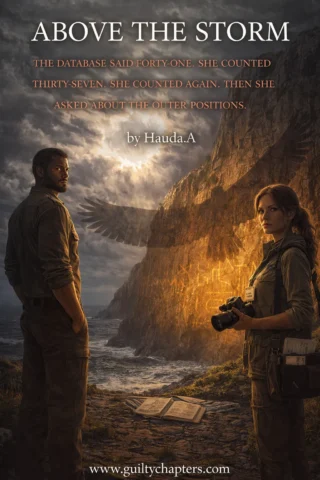
The storm had uncovered the panel.
He’d known the panel was there. Everyone in the community knew it was there — buried under six decades of vegetation growth since the slope collapse that had covered it in his grandfather’s time. His grandfather had considered it a loss. His father had considered it the kind of thing that would resolve itself eventually. Finn had grown up knowing the panel was buried behind the slope and thinking of it as the community’s record that the hillside was keeping for them.
The hillside had given it back.
He’d seen the exposed rock face before Willa reached it. He’d come up the path from the community side, Monday morning post-storm, doing the cliff check he always did after significant weather, and he’d rounded the upper path junction and seen the slope failure and the exposed panel, and stood there for a moment with his grandfather’s description in his head — *the full territory record, the long version, back to the beginning* — and thought: *she’s going to find this in forty minutes.*
He’d walked down to meet her on the path.
He’d watched her photograph it systematically, methodically, with the scale marker and the section-by-section approach. He’d watched her identify the lower section as population records before he’d said a word. He’d stood beside her and thought: *this is the decision, right here, and I’ve already made it.*
He’d told her to come back to the cottage tonight.
Now he was at the communal kitchen with his mother.
He said: “The storm uncovered the panel.”
She said: “I know. Soren and Davo were on the north cliff at dawn.”
He said: “She photographed it.”
His mother said: “I know that too.”
He said: “She identified the lower section as population records on her own.”
His mother was quiet.
He said: “I told her I’d come to the cottage tonight and tell her what I can.”
His mother looked at him.
He said: “She asked if they were heritage program material and when I said they weren’t she asked what I wanted her to do with the photographs. She didn’t assume. She asked.”
His mother said: “I know.”
He said: “I’ve been managing researcher visits for ten years. I have never been in a situation where a researcher asked me what I wanted them to do.”
His mother said: “I know that too.”
He said: “She told Lena she’d like to understand what’s happening here before she writes anything.”
His mother said: “Finn.”
He said: “I know what you’re going to say.”
She said: “I’m going to say: your eagle has been certain since her truck came up the coast road. You’ve been catching up. The panel is uncovered and she photographed it and she asked you what you wanted her to do. What are you actually deciding?”
He said: “Whether to tell her everything.”
His mother said: “Is that the decision?”
He said: “Isn’t it?”
She said: “The decision is whether to trust her. You can tell her everything or not. But the decision underneath is whether you trust her with the community’s safety.”
He said: “Two weeks isn’t long enough to know.”
His mother said: “Your eagle knew from the coast road.”
He said: “My eagle’s timeline is not the timeline I’m operating on.”
His mother said: “I understand that. But you’ve been watching her for two weeks and she has been, on every single occasion, exactly who she appears to be. She’s asked direct questions and received partial answers and responded to the partial answers with professional patience rather than pressure. She moved her monitoring equipment appropriately when you redirected it. She said the birds are safe here. She asked you what you wanted her to do with the photographs.”
He said: “People can be all of those things and still make a decision that compromises the community.”
His mother said: “Yes. What does your eagle say.”
He was quiet.
His mother said: “What does your eagle say, Finn.”
He said: “That she’s not a threat.”
His mother said: “Has it been wrong before.”
He thought about the times his eagle had given him a clear read on a person — the documentary filmmaker who had been redirectable; the graduate student who had been genuinely just there for the dissertation data; the previous researcher before Petersen who had been interested in the habitat numbers and nothing else. His eagle had never flagged any of them as safe in the particular way it had flagged this one.
He said: “No.”
His mother said: “Then go to the cottage tonight.”
He said: “And tell her.”
She said: “Tell her what you can. Tell her as much as you’ve decided is right.” She paused. “And listen to your eagle.”
He said: “My eagle’s opinion tends to have an agenda.”
His mother almost smiled. She said: “All of our opinions have an agenda. The question is whether the agenda is worth trusting.” She stood. “Go. Be honest. See what she does with it.”
He said: “If she makes a decision that compromises the community —”
His mother said: “She won’t.”
He said: “You’re certain.”
She said: “I was watching her face at dinner. I watched her at the window when she told me the birds are safe here.” His mother picked up her coat. “I’ve been watching people come to this headland for thirty years, Finn. I know the ones we need to manage and I know the ones who are different.” She paused. “She’s different.”
He drove to the cottage at six.
She was at the table with the photographs from the upper headland panel spread across it — printed, she’d printed them at the cottage’s small printer — with notes and cross-references in her notebook.
She looked up when he knocked.
She said: “Come in.”
He came in.
He looked at the photographs on the table — the panel’s population records, the territorial markings that went back to the beginning of the community’s time on this headland, the marks his grandfather had described and his father had shown him in drawings and that he’d been keeping the location of for twenty years.
He looked at her face. The still, focused, honest face of someone who was waiting for what he had to say.
He thought: *this is the decision.*
He sat down.
He said: “The markings are the community’s territorial record. The lower section is the population record — the eagle population, this cliff, going back to the first generation of the community here. The upper section is the clan’s own history.”
She said: “How far back.”
He said: “Further than the 1890s journals.” He paused. “Much further.”
She said: “How much further.”
He said: “The oral history gives us twelve generations on this headland. Some marks on the panel are older than that.”
She said: “That’s five or six hundred years, conservatively.”
He said: “At minimum.”
She looked at the photographs.
She said: “Show me the rest.”
He said: “Are you sure?”
She said: “I’ve been sure since day four.”
He looked at her.
He said: “Tomorrow. The cliff face, at low tide.” He paused. “All of it.”
She said: “Tomorrow.”
He said: “Yes.”
She wrote something in her notebook.
He thought: *tomorrow.*
He thought: *she said I’ve been sure since day four.*
He thought: *I’ve been sure since her truck came up the coast road.*
He thought: *tomorrow.*


Reader Reactions